You are spending money on Google Ads every month. The leads come in while the budget runs, and stop the moment it does. Someone tells you SEO is the answer — free traffic, long-term, compounding. But it takes six months before you see anything. So which do you actually do?
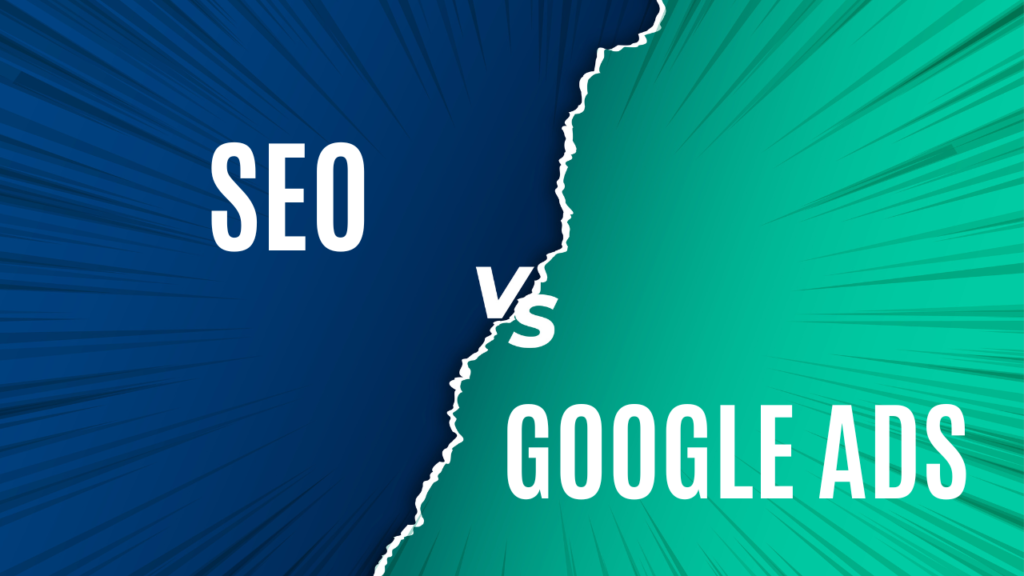
The SEO vs Google Ads debate is one of the most common decisions small business owners face when they start thinking seriously about digital marketing. The honest answer is more nuanced than most articles will tell you — and it depends entirely on where your business is right now.
SEO vs Google Ads — what is actually different
Before getting into which is better, it helps to be clear on what each one actually does — because a lot of the confusion comes from treating them as interchangeable.
Google Ads buys placement. You can read how the auction system works in Google’s official Ads documentation. You bid on keywords, pay for each click, and appear at the top of search results with a small “Sponsored” label. Traffic starts the day your campaign goes live. It stops the day your budget runs out. The cost per click in competitive industries can be significant — in finance or legal it is not unusual to pay $20 to $50 per click. In less competitive niches, $2 to $8 is more typical.
SEO earns placement. You improve your site’s content, technical health, and authority so that Google ranks you organically — without paying for each visitor. Traffic takes months to build but once it arrives, it does not stop when you pause a payment. A page that ranks well today will likely still rank in twelve months with minimal ongoing investment. Google explains how organic ranking works here.
Ads rent your traffic. SEO buys it. The economics look very different after month twelve.
Where SEO wins
Long-term cost per lead
This is the clearest advantage. Once your SEO is producing consistent organic traffic, the cost per lead drops dramatically — and keeps dropping. You are not paying per click. The content you published six months ago is still generating enquiries today at zero additional cost. Over a 12 to 24 month horizon, SEO almost always produces a lower cost per lead than paid search for small businesses.
Traffic that compounds
Every piece of content you publish, every backlink you earn, and every technical improvement you make compounds. A blog post published today might rank on page three in month three, move to page one in month six, and continue generating traffic for years. Google Ads produces no compounding effect — this month’s spend produces this month’s clicks and nothing more.
Trust and credibility signals
Organic results are trusted differently than paid results. Studies consistently show that users click organic results more than paid ones for most search types — particularly for research-phase queries where buyers are evaluating options. Ranking organically signals to a searcher that Google considers you a credible source. An ad just means you paid to be there.
It protects you from rising ad costs
Google Ads costs increase over time in competitive markets as more businesses bid on the same keywords. A business that builds strong organic rankings is increasingly insulated from this — they are getting free traffic for keywords that competitors are paying more and more to appear for.
Where Google Ads wins
Speed
This is the defining advantage. A Google Ads campaign can be live in 24 hours and producing leads by the end of the week. SEO takes months. If you need leads now — if your pipeline is dry, if you have launched a new service, if you have just moved to a new market — Ads is the only way to get search traffic immediately.
Targeting precision
Google Ads lets you target specific keywords, locations, times of day, device types, and audience segments with granular precision. You can run a campaign that shows your ad only to people in a specific city, searching for a specific phrase, on mobile, between 9am and 5pm. SEO gives you much less control over exactly who sees your content and when.
Testing
Ads are the fastest way to find out which messages, offers, and landing pages convert. You can run two versions of an ad, get statistically meaningful data within days, and use those learnings to improve your SEO content and landing pages. Many businesses use Ads specifically as a testing environment before investing in longer-term SEO content.
High-competition keywords
For some keywords, page-one organic rankings are genuinely very difficult to achieve for a small business in a reasonable timeframe — the competing pages have years of authority and thousands of backlinks. Ads lets you appear for those keywords immediately, even if organic ranking is a 12 to 18 month project.
SEO vs Google Ads — head to head comparison
SEO — Organic Search
The long-term asset
- Traffic continues after you stop investing
- Cost per lead drops over time
- Builds domain authority and trust
- Compound returns — every month builds on the last
- No cost per click
- Works 24/7 without active management
Google Ads — Paid Search
The immediate lever
- Traffic starts within 24 to 48 hours
- Precise keyword and audience targeting
- Easy to test messages and offers quickly
- Works for highly competitive keywords immediately
- Completely controllable — pause or scale anytime
- Clear, measurable ROI from day one
| Factor | SEO | Google Ads | Winner |
|---|---|---|---|
| Time to first traffic | 3–6 months | 24–48 hours | Google Ads |
| Long-term cost per lead | Decreases over time | Fixed or rising | SEO |
| Traffic when you stop paying | Continues | Stops immediately | SEO |
| Targeting control | Limited | Very precise | Google Ads |
| Trust signal to searchers | High — organic result | Lower — labelled ad | SEO |
| Testing speed | Slow — weeks to months | Fast — days | Google Ads |
| Budget required upfront | Time and content | Cash per click | SEO |
| Works for new sites immediately | No | Yes | Google Ads |
| 12-month ROI (average SMB) | Higher | Lower | SEO |
| Compounds over time | Yes | No | SEO |
How to decide which to do first
The right answer depends on three questions about your specific situation right now.
Answer these three questions first
- Do you need leads in the next 30 to 60 days?If yes — start with Google Ads. SEO will not produce meaningful traffic in that timeframe. Use Ads to generate immediate leads while SEO builds in the background.
- Can you wait 4 to 6 months for the first results?If yes — prioritise SEO. You will build an asset that compounds in value over time and reduces your paid traffic dependency permanently.
- Do you have budget for both?If yes — run both. Ads bridge the gap while SEO builds. Use Ads data to inform which keywords to target in SEO. Reduce Ads spend as organic traffic grows.
The case for running both — and how to do it without wasting budget
Most small businesses that think about this as an either/or choice are making it harder than it needs to be. The real question is not “SEO vs google Ads” — it is “how do I use each one for what it is actually good at?”
Here is the SEO vs Google Ads approach we recommend to most small business clients at Digital Advance Growth:
Months 1 to 3: Run a small, tightly targeted Google Ads campaign — enough to generate consistent leads and keep the pipeline moving. Simultaneously, start SEO fundamentals — technical fixes, keyword targeting, first pieces of content. Use the Ads data to see which keywords convert best, and let that inform your SEO keyword priorities.
Months 4 to 6: SEO starts producing early rankings for long-tail keywords. First organic traffic appears. Ads remain active but you start reducing spend on keywords where organic rankings are appearing — no point paying for clicks you are now earning for free.
Months 7 to 12: SEO is generating meaningful, consistent organic traffic. Ads budget is redirected to high-competition keywords where organic ranking is still months away — or paused entirely for keywords where organic now dominates. The cost per lead from organic is a fraction of what it was from Ads a year ago.
The goal is not to choose between SEO vs google ads. It is to use Ads to bridge the gap while SEO builds the asset that eventually replaces them.
This approach means you never have a period of zero leads while SEO builds, and you never waste years worth of Ads budget when SEO could be doing that work for free. It is how the full-funnel digital marketing system we build for clients works in practice.
The one mistake to avoid Running Google Ads without tracking conversions. If you cannot see which keywords, ads, and landing pages are producing leads — not just clicks — you are spending money blind. Set up conversion tracking in Google Ads and Google Analytics before you spend a single rupee on clicks. Our digital marketing service includes this as a non-negotiable starting point.
The bottom line
Still weighing up SEO vs Google Ads for your business? Tired of paying for every click with nothing to show for it the moment you pause? That is the clearest signal that SEO should be a priority alongside whatever you are spending on Ads.
Launched a new service or need leads this month? Ads are the right tool for now — but start building SEO content in parallel so you are not in this same position in twelve months.
The businesses we see winning on Google are almost never the ones who chose one and ignored the other. They are the ones who understood what each channel is good at and used both deliberately — shifting budget from Ads to SEO as organic rankings grow, and using Ads data to make SEO smarter.
If you want help working out the right mix for your specific business — and want to ensure your site is visible in both Google and AI search tools like ChatGPT and Perplexity, our SEO service starts with a free audit that covers your current traffic, keyword opportunities, and exactly what we would do first. It takes 24 hours and costs nothing.
SEO vs Google Ads — frequently asked questions
Q: Should I do SEO vs Google Ads for my small business?
A: It depends on your timeline and budget. If you need leads within 30 to 60 days, Google Ads gives immediate visibility while SEO builds. If you have 6 to 12 months before needing significant organic traffic, SEO is the higher-ROI long-term investment. Most small businesses benefit from running both — Ads for immediate leads, SEO for the long-term asset that reduces ad dependency over time.
Q: Is SEO better than Google Ads?
A: SEO produces better long-term ROI for most small businesses — but only after the initial 3 to 6 month build period. Google Ads produces immediate traffic but stops the moment you stop paying. SEO traffic compounds and continues indefinitely. The right answer depends on your timeline, how competitive your keywords are, and how much budget you have available.
Q: How much does Google Ads cost for a small business?
A: It varies significantly by industry. In competitive niches, cost per click can be $10 to $50 or more. For most small business service categories, $500 to $2,000 per month is a realistic starting budget. The key metric is cost per lead — a $1,000 monthly budget producing 5 qualified leads at $200 each may be excellent or poor depending on your average client value.
Q: Can SEO replace Google Ads?
A: Yes — over time. Many small businesses that invest in SEO consistently for 12 to 18 months reduce or eliminate Google Ads spend because organic search generates enough leads independently. This is typically the long-term goal: use Ads to bridge the gap while SEO builds, then reduce Ads dependency as organic traffic grows.
Q: What is the difference between SEO vs Google Ads?
A: SEO earns organic rankings through content quality, technical site health, and backlinks — free traffic once rankings are achieved but takes months to build. Google Ads buys paid placements at the top of search results — traffic starts immediately but costs money per click and stops when budget runs out. Both appear in Google search results but in different positions and with different economics.
Find out the right mix for your business — free.
We review your current traffic, competitive landscape, and budget — then tell you specifically whether to start with SEO, Ads, or both, and why.
Get a Free Audit
- SEO Audit Checklist: 40 Checks You Can Run With Free Tools - October 20, 2026
- How to Track Your Brand’s Visibility in ChatGPT and AI Search - October 3, 2026
- AEO vs GEO vs SEO: What’s the Difference? (2026 Guide) - September 23, 2026