One Agency vs Multiple Vendors Marketing: Which Model Actually Grows Your Business?

One Agency vs Multiple Vendors

One agency vs multiple vendors marketing — which is better?
It depends on your business size, budget, and goals. A single integrated agency offers better coordination, faster execution, and clearer accountability — ideal for SMBs and growth-stage businesses. Multiple specialized vendors give you best-in-class expertise for each channel but require more internal management and come with higher coordination overhead. For most growing businesses, starting with one full-service agency and layering in specialists later is the smarter path.

You hired an SEO agency. A separate social media freelancer. A PPC consultant. A web designer who “does a bit of content too.” And somehow, after six months and four invoices, your website traffic is still flat, your leads are inconsistent, and nobody can agree on why.

Sound familiar?

This is the hidden cost of the multiple vendor marketing model — and it affects thousands of small businesses and startups every year.

The debate between using one agency vs multiple vendors for marketing is not just a preference question. It is a strategic decision that directly determines how fast your business grows, how efficiently you spend your budget, and whether your marketing compounds over time or stagnates in silos.

In this guide, we break down both models in full detail — the real advantages, the real risks, the costs most agencies and vendors do not tell you about, and a clear framework to help you decide which approach is right for your business right now.

What Is the “One Agency” Marketing Model?

TThe one agency model means partnering with a single, full-service marketing agency that handles all (or most) of your digital marketing needs under one roof. This includes:

  • SEO and content marketing
  • Paid search (Google/Bing Ads)
  • Paid social (Meta, LinkedIn, TikTok)
  • Email marketing and automation
  • Web design and CRO
  • Analytics and reporting

Think of it as hiring a complete marketing department — without the overhead of full-time employees.

Who it’s best for:

Growth-stage companies scaling their digital presence

SMBs and mid-market companies

Businesses without a dedicated internal marketing team

Brands that want faster execution and less management time

What Is the “Multiple Vendors” Marketing Model?

TThe multiple vendors model means hiring separate specialist agencies or freelancers for each marketing channel. For example:

  • A boutique SEO agency for organic search
  • A PPC specialist agency for paid ads
  • A social media agency for content and community
  • A separate email marketing consultant
  • A web design studio for development

Who it’s best for:

Organizations with strong internal project management capacity

Enterprise businesses with a dedicated in-house marketing manager

Companies with complex, high-budget campaigns in specific channels

Brands in highly competitive niches where specialist expertise is critical

One Agency vs Multiple Vendors Marketing: A Full Comparison

1. Strategy Alignment

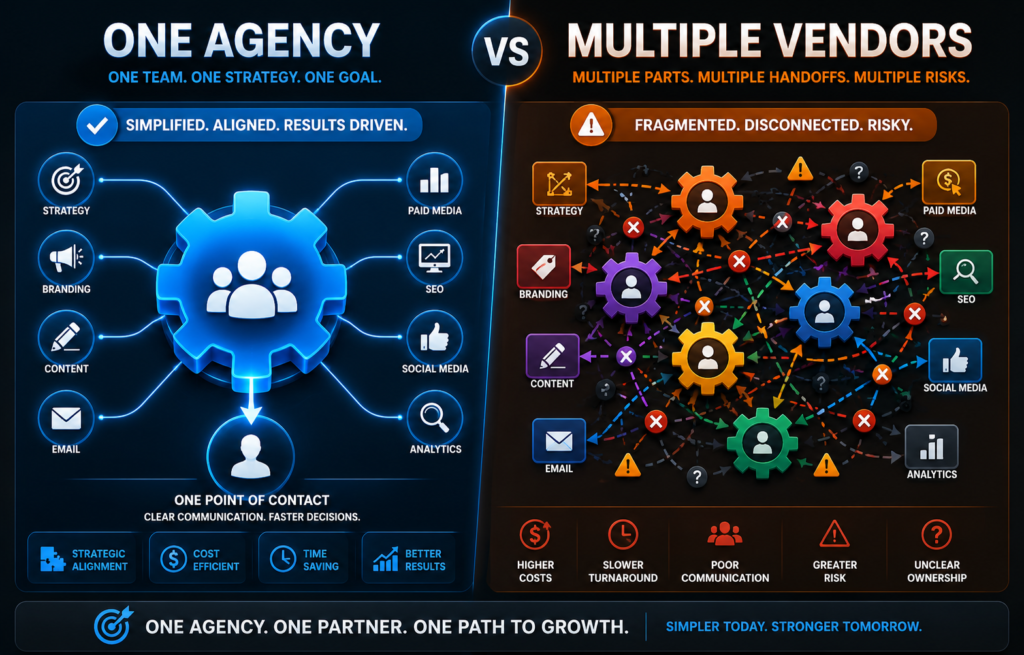
One agency: One strategy governs every channel. The SEO keyword research informs the content calendar. The content informs the social media posts. The social media data informs the paid ads targeting. Everything reinforces everything else — naturally, without extra effort.

Multiple vendors: Each vendor builds their own mini-strategy for their own channel. Your SEO agency optimises for one set of keywords. Your content freelancer writes about what they think is relevant. Your PPC consultant targets an audience that may or may not match the SEO strategy. The result is fragmented messaging, inconsistent audience targeting, and campaigns that never build on each other.

Winner: One agency — and it is not close.

2. Communication and Coordination Overhead

One agency: One monthly strategy call. One point of contact. One monthly report covering all channels. One person who knows your business, your goals, your audience, and your history.

Multiple vendors: Separate calls with each vendor. Separate reports you have to reconcile yourself. Separate invoices. Separate onboarding processes every time you bring in someone new. And when something goes wrong — say, your paid ads are not converting — you have to play referee between your PPC consultant, your web designer, and your SEO agency to figure out whose fault it is.

That coordination time is not free. If you are spending three to four hours per week managing vendors, you have created a part-time job for yourself — before you have done any actual work on your business.

Winner: One agency.

3. Channel Synergy and Compounding Results

This is the most important factor most businesses ignore when making this decision.

Marketing channels do not operate in isolation. They interact, reinforce, and amplify each other. When they are managed together:

  • SEO + Content: Blog content is written to rank for the exact keywords your SEO strategy targets — not just what seems interesting to a freelance writer.
  • SEO + PPC: Organic ranking data tells your paid ads team which keywords already convert, so you stop spending budget on guesswork.
  • Social + Content: High-performing blog posts are repurposed into social content, driving traffic back to pages that are already generating leads.
  • Web Design + CRO + SEO: Your website is built for both search engine performance and conversion from day one — not as three separate, often conflicting priorities.

When these channels are managed by different vendors who rarely speak to each other, you lose every one of these synergies. You end up paying for the same work multiple times — keyword research done by the SEO agency, done again by the content freelancer, done again by the PPC consultant.

Winner: One agency — significantly.

4. Cost Transparency and Total Budget Efficiency

One agency: One fixed monthly fee. Usually includes a defined scope of work across all channels. Easier to forecast, easier to track ROI against.

Multiple vendors: Each vendor charges separately. Scope creep happens vendor by vendor. You end up paying for overlapping work (multiple vendors doing their own “strategy” sessions, their own reporting, their own research). And when results are underperforming, identifying which vendor’s budget to cut requires data coordination none of them are incentivised to provide honestly.

The average small business using three to five vendors spends 20–35% of their total marketing budget on coordination, duplication, and vendor management overhead that generates zero marketing output.

Winner: One agency — for budget efficiency.

5. Accountability and Reporting

One agency: One report. One set of KPIs. One team accountable for the full picture — traffic, leads, conversions, and revenue impact. If results are underperforming, there is one conversation to have.

Multiple vendors: Each vendor reports on their own channel metrics. Your SEO agency reports rankings and organic traffic. Your PPC consultant reports click-through rates and ad spend. Your social media freelancer reports followers and engagement. Nobody reports the number that actually matters — qualified leads generated and revenue produced — because no single vendor owns that number.

This is how businesses spend 18 months paying for marketing they cannot evaluate, because they have no unified view of what is actually working.

Winner: One agency.

6. Speed to Execution

One agency: Strategy decisions translate into execution within the same team. No briefing documents shared between vendors. No waiting for four separate parties to align on a campaign launch.

Multiple vendors: Every cross-channel campaign requires briefing every vendor separately. Approvals from multiple parties. Conflicting timelines. And if one vendor is slow or drops the ball, the entire campaign stalls.

Winner: One agency.

7. Specialist Depth

This is where the multiple vendor model has a legitimate argument.

A specialist SEO agency that does nothing but SEO every day for every client may, in some cases, have deeper technical expertise than the SEO team within a full-service agency. The same applies to specialist PPC consultants, specialist social media agencies, and so on.

However — this advantage only matters if:

  1. You have the in-house marketing management capacity to coordinate all those specialists
  2. The specialists actually communicate and share data with each other (they rarely do)
  3. Your business is large enough that channel-specific deep expertise outweighs the coordination cost

For most small businesses and startups, the strategy alignment and synergy advantages of one agency far outweigh the marginal specialist depth advantage of multiple vendors.

Winner: Multiple vendors (specialist depth only) — but with significant caveats.

8. Relationship and Business Understanding

One agency: Over time, your agency partner develops deep institutional knowledge of your business — your audience, your offer, your competitive position, your seasonal patterns, what has worked and what has not. That knowledge compounds. A three-year relationship with one agency is worth far more than the sum of its monthly retainers.

Multiple vendors: Each vendor has a partial view of your business. None of them have the full picture. When you replace one vendor (which happens frequently), you lose their partial institutional knowledge and restart from zero in that channel.

Winner: One agency.

When Multiple Vendors Actually Makes Sense

To be fair, the multiple vendor model does work — in specific circumstances:

1. You have a senior in-house marketing manager. If your business has a VP of Marketing or experienced Marketing Director whose full-time job is to coordinate vendors, set strategy, and own the reporting function, specialist vendors can genuinely deliver channel-specific depth that a generalist agency cannot match.

2. Your business is at enterprise scale. Large companies with complex marketing operations, significant budgets, and dedicated marketing teams can manage the coordination cost of multiple specialist agencies. For a startup or SMB, this overhead is prohibitive.

3. You need a very specific, temporary specialist capability. If your full-service agency does not offer a specific capability you need for a defined project — a specialist PR firm for a product launch, a specialist video production company for a one-off campaign — bringing in a single additional vendor for a defined scope makes sense. This is not the same as building your entire marketing operation from multiple vendors.

4. You are testing a new channel before committing. Before adding a new channel to your core strategy, running a short-term pilot with a specialist vendor to validate the opportunity is a reasonable approach — as long as you then integrate that channel into your primary agency relationship if it proves out.

Step-by-Step Guide: How to Choose the Right Marketing Model for Your Business

Step 1: Audit Your Current Marketing Structure

Before deciding between one agency and multiple vendors, get a clear picture of where you are right now.

Answer these questions honestly:

  • How many vendors are you currently paying for marketing?
  • How many hours per week do you personally spend coordinating them?
  • Do you have a single, unified marketing strategy — or is each vendor running their own?
  • Can you look at one report and see your total qualified leads generated this month?
  • Are your marketing channels reinforcing each other, or operating independently?

If you answered “no” to most of the last three questions, the multiple vendor model is costing you more than you think.

Step 2: Define Your Business Stage and Budget Reality

Your marketing model should match where your business is right now.

Early-stage startup (pre-revenue or early revenue): Focus is on proving product-market fit and generating the first leads. Budget is tight. One integrated partner who handles SEO, content, and web from day one is almost always the right choice — you cannot afford the coordination overhead of multiple vendors, and you need results that compound.

Growing SMB (established revenue, looking to scale): You have proven your offer works. Now you need to scale channels that are already showing traction. A full-service agency that can own the entire growth system — SEO, paid, social, content — and report on it as a unified whole gives you the speed and accountability you need without the vendor management overhead.

Established business with in-house marketing team: You may have genuine need for specialist vendors in specific channels, coordinated by your in-house team. But even here, a primary agency relationship managing the integrated strategy makes execution more efficient.

Step 3: Evaluate Agencies Against the Right Criteria

If you decide a single integrated agency is right for your business, do not evaluate on price alone. Evaluate on:

Strategy depth: Does the agency start with a documented strategy — audience, keywords, messaging, conversion path — before any execution? Or do they start building immediately without understanding your business?

Channel integration: Can they demonstrate how their SEO, content, social, and paid channels share data and reinforce each other? Ask for a specific example from a current client.

Reporting transparency: Do they report on business outcomes — leads, conversions, revenue impact — or just channel metrics like rankings and followers? Demand plain-language, outcome-focused reporting.

Contract terms: Month-to-month arrangements mean the agency earns your business every month through results. Long-term contracts lock you in regardless of performance. Choose accordingly.

Proven results for businesses like yours: Has the agency delivered results for businesses at your stage, in your industry, with a similar budget? Ask for case studies and be specific about what you want to see.

Step 4: Structure the Engagement for Maximum Compounding

Once you have selected an integrated agency, set up the engagement for success.

Week 1 — Full audit and baseline: Before any execution begins, your agency should conduct a full audit — SEO performance, website speed and conversion architecture, content gaps, competitor analysis, and channel-by-channel baseline metrics. This is the foundation everything else builds on.

Week 1–2 — Strategy and 90-day roadmap: A documented plan with clear KPIs, timelines, and budget allocation — approved by you before a single campaign goes live. This eliminates the “we were just doing what we thought was best” excuse later.

Ongoing — Unified execution: All channels managed against the same strategy. SEO and content aligned to the same keyword priorities. Paid ads informed by organic performance data. Social media reinforcing the content strategy. Every channel connected.

Monthly — Unified reporting: One report covering all channels — what produced qualified leads, what to change, and specific next actions. Not four separate reports from four separate vendors that you have to reconcile yourself.

Step 5: Review and Scale What Works

At the 90-day mark, review results against the baseline established at the start.

The key questions:

  • Which channels are producing the most qualified leads?
  • Which content is driving organic traffic growth?
  • Where is budget producing the strongest return?
  • What does the next 90 days look like based on what we have learned?

With one integrated agency, this review is one conversation with one team who has the full picture. They can shift budget between channels, double down on what is working, and cut what is not — without losing momentum or requiring four separate conversations.

The True Cost Comparison: One Agency vs Multiple Vendors

Here is what the real cost comparison looks like for a typical small business spending £3,000/month on marketing:

Multiple Vendor Model (£3,000/month total)

VendorMonthly CostHidden Cost
SEO Agency£800Separate reporting, no content alignment
Freelance Content Writer£600No keyword strategy input
PPC Consultant£900 (inc. management fee)No organic data integration
Social Media Freelancer£500No content repurposing
Web Developer (ad-hoc)£200No CRO integration
Your coordination time£0 (but 4–6 hrs/week)Strategy gap, no unified reporting

Result: Four channels operating independently. No compounding. Heavy management overhead. No single person accountable for overall performance.

One Integrated Agency Model (£3,000/month total)

What You GetValue
Unified SEO + content + social strategyOne strategy, all channels
Monthly outcome reportingLeads and conversions, not vanity metrics
One point of contactZero coordination overhead
Shared data across channelsSEO insights inform paid ads, vice versa
Compounding resultsMonth 3 builds on Month 1. Month 12 pays dividends

Result: Fewer channels, perhaps — but connected execution, compounding results, and a clear view of what is working.

Common Mistakes Businesses Make With Multiple Vendors

Mistake 1: Assuming more specialists always means better results. Specialist depth in isolation does not produce better marketing results. Integrated execution does. The best SEO strategy in the world does not help you if your content, social, and web are pulling in different directions.

Mistake 2: Underestimating coordination cost. Most businesses do not count their own time as a cost. If you spend five hours per week managing vendors, that is five hours not spent on product, sales, or client delivery. At any reasonable valuation of your time, that is a significant cost — and it grows as you add more vendors.

Mistake 3: Letting vendors self-report without a unified view. Each vendor reports the metrics that make them look best. Your SEO agency reports rankings. Your social media freelancer reports follower growth. Your PPC consultant reports click-through rates. None of them report the number that matters: qualified leads generated and cost per lead. Without a unified view, you cannot make good budget allocation decisions.

Mistake 4: Replacing vendors instead of fixing the model. When results underperform with a multiple vendor setup, most businesses replace the underperforming vendor rather than questioning whether the model itself is the problem. A new PPC consultant will not fix a strategy problem that exists because your SEO, content, and paid channels are not aligned.

Mistake 5: Waiting until the pain is severe before switching. Every month you spend with a fragmented vendor model is a month where your marketing is not compounding. The compounding effect of integrated marketing — where Month 12 produces significantly more output per pound than Month 1 — is the most valuable thing you can build. Starting later means the compounding starts later.

Hidden Costs Nobody Talks About

The Real Cost of Multiple Vendors

Most businesses calculate vendor costs wrong. They add up the monthly retainers and stop there. But the true cost includes:

  • Your time managing vendors: 5–10 hours/week × your hourly value
  • Briefing and onboarding every time a vendor turns over
  • Data reconciliation across platforms
  • Campaign delays from slow approvals and handoffs
  • Inconsistent brand assets that need constant correction

For a business owner valuing their time at $200/hour, 8 hours/week of vendor management = $83,200/year in hidden cost.

The Real Cost of One Agency

One agency has its own risk profile:

  • Dependency: If they underperform, your whole marketing operation is affected
  • Generalist ceilings: Full-service agencies may have weaker depth in specific channels
  • Switching friction: Consolidating data and transition can take 30–60 days

Neither model is free of cost. Your job is to match the model to your actual resources and risk tolerance.

What the Data Says

  • Companies with integrated marketing programs report up to 3x higher revenue growth compared to siloed approaches (LinkedIn B2B Institute)
  • Businesses that consolidate to a single agency see an average 23% reduction in total marketing spend in year one due to eliminated redundancies
  • Brands with unified messaging across channels achieve 18–25% higher customer lifetime value compared to brands with fragmented messaging

These numbers exist because consistency compounds. When every channel tells the same story to the same audience, the cumulative impact multiplies.

Which Model Do Growth Agencies Recommend?

Most experienced growth agencies will tell you: start unified, then strategically specialize.

The logic is sound. In the early and mid stages of business growth, strategic alignment and execution speed matter more than channel-specific optimization. You capture 80% of available results from a well-coordinated generalist approach.

Once you’ve established baseline performance, identified your highest-ROI channels, and built the internal bandwidth to manage additional vendors — then layer in specialists.

Learn how Digital Advance Growth structures integrated marketing programs for SMBs

Common Mistakes to Avoid

Mistake 1: Hiring multiple vendors to “cover all bases” with a limited budget Result: Every vendor gets too little budget to run meaningful campaigns.

Mistake 2: Not requiring unified tracking from Day 1 Result: Siloed data that’s impossible to reconcile into a clear performance picture.

Mistake 3: Choosing an agency based on case studies from a different industry Result: Strategies that worked in eCommerce don’t translate to B2B services. Ask for vertical-specific proof.

Mistake 4: No agreed KPIs before signing Result: Months of “activity reporting” with no accountability to outcomes.

Mistake 5: Confusing vendor count with marketing sophistication Result: Paying for the feeling of a robust marketing operation while your CAC keeps rising.

How Digital Advance Growth Solves the One Agency vs Multiple Vendors Problem

Digital Advance Growth is built specifically around the integrated model — designed for small businesses and startups who need every channel working as one system, not as separate functions with separate invoices.

Here is what that looks like in practice:

Six services, one strategy. SEO, AI-driven marketing, web design, social media, ecommerce, and full-funnel digital marketing — all managed as one connected growth system. Every channel shares data, messaging, and strategy. Results compound month over month.

One point of contact. You speak to one team who knows your business completely — not four vendors who each know one slice of it. One monthly call. One monthly report. One invoice.

Strategy before execution — always. Every engagement starts with a full audit and a documented 90-day roadmap, approved by you before any campaign goes live. Tactics without strategy is the most expensive form of digital marketing.

Transparent, outcome-focused reporting. Monthly plain-language reports on qualified traffic, leads, and conversions. Not impressions, followers, or rankings in isolation — the metrics that tell you whether your marketing is producing revenue.

Month-to-month. No long-term contracts. The results produced — not a retainer lock-in — maintain the relationship. Every month is earned.

Free 24-hour audit to start. Before any commitment, get a full audit of your website, SEO performance, and digital marketing gaps — delivered within 24 hours, at no cost.

Conclusion: Stop Splitting Your Marketing. Start Compounding It.

The one agency vs multiple vendors marketing debate comes down to one question: do you want channels that operate in isolation, or a system where every activity builds on the last?

Multiple vendors can work — but only if you have the in-house team, the coordination bandwidth, and the unified reporting infrastructure to make them function as one. Most small businesses and startups do not. And every month spent managing fragmented vendors is a month where your marketing is not compounding.

The businesses that grow fastest are not the ones with the most vendors. They are the ones with the clearest strategy, the most aligned execution, and one team accountable for the full picture.

If your current setup has four invoices, four reports, and no single answer to “how many qualified leads did we generate this month?” — that is not a vendor problem. That is a model problem.

One strategy. One team. One growth system that builds month over month.

That is what integrated marketing looks like — and it is exactly how Digital Advance Growth works with every client, from day one.

Get Your Free 24-Hour Marketing Audit →

No commitment. No long-term contract. Just a clear picture of where your marketing is losing leads right now — and what to do about it.

FAQ Section

Q1: Is it better to use one marketing agency or multiple vendors?

Ans: For most SMBs and growth-stage businesses, one integrated agency is better. It offers unified strategy, consolidated reporting, faster execution, and clearer accountability. Multiple vendors make sense for enterprises with dedicated internal marketing teams and budgets exceeding $15,000/month.

Q2: What are the biggest risks of using multiple marketing vendors?

Ans: The top risks are: accountability gaps (each vendor blames others for poor results), siloed data that obscures true ROI, brand inconsistency across channels, high coordination overhead, and campaign delays caused by multi-vendor handoffs.

Q3: How do I know if my current agency is a full-service agency or just a specialist?

Ans: Ask them directly: which services do you deliver in-house vs. through sub-contractors? Request case studies showing multi-channel campaign management. A true full-service agency should show integrated results — not just channel-specific wins.

Q4: Can I switch from multiple vendors to a single agency without losing momentum?

Ans: Yes, but plan for a 30–60 day transition period. Ensure all historical campaign data, ad accounts, analytics access, and brand assets are transferred before the old vendors are offboarded. Run a 2–4 week parallel period where both are active to prevent gaps in coverage.

Q5: What should I look for in a full-service marketing agency?

Ans: Look for: proven multi-channel case studies (not just one channel), transparent unified reporting, dedicated account management (not ticket-based support), clear KPI commitments, and cultural fit with your business. Avoid agencies that make guarantees on rankings or ad spend returns before auditing your current state.

Leave a Comment

Your email address will not be published. Required fields are marked *

Scroll to Top