Quick answer: One agency vs multiple vendors — for most small businesses, the answer is clear: one full-service marketing agency delivers better ROI, faster execution, and clearer accountability than managing multiple marketing vendors. The hidden cost of coordinating vendors — your time, energy, and strategic misalignment — almost always outweighs the perceived benefit of specialisation.
If you’ve ever juggled an SEO agency, a Google Ads freelancer, a social media manager, and a content writer at the same time — you already know the chaos. Everyone is doing their job, but nothing quite connects. That’s the core problem this post addresses.
The Real Problem With Multiple Marketing Vendors
On paper, hiring specialists for every marketing channel sounds logical. You get an SEO expert for rankings, a PPC specialist for ads, a designer for creatives, and a content writer for blogs. Maximum expertise in every lane.
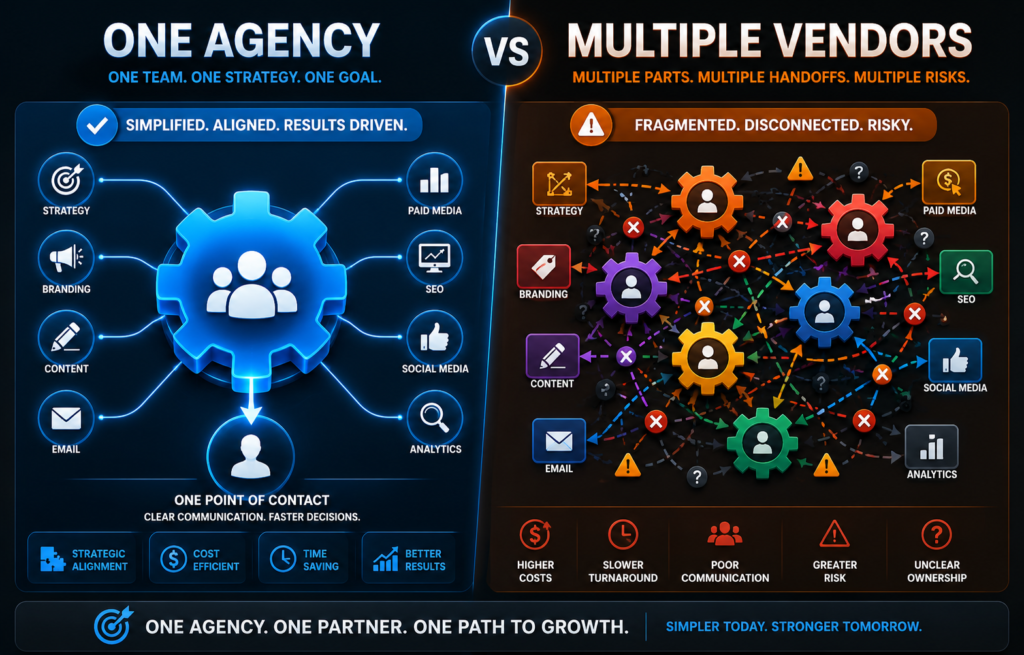
In practice, this creates a system where every vendor optimises locally — for their own metrics — while nobody is optimising globally for your business results.
Here is what actually happens:
- Your SEO team drives traffic to a page your web developer built without conversion in mind
- Your PPC agency runs ads to a landing page the content team never updated
- Your social media manager posts content the brand team hasn’t approved
- When leads don’t convert, every vendor points at someone else
This is what industry practitioners call the specialist trap: fragmented vendors can’t see the full funnel, so they optimise locally instead of globally.
One Agency vs Multiple Vendors: Side-by-Side Comparison
Here’s a direct comparison across the factors that matter most for small businesses:
Here’s a direct comparison across the factors that matter most for small businesses:
| Factor | One Full-Service Agency | Multiple Vendors |
| Strategy alignment | ✅ Unified across all channels | ❌ Each vendor optimises in isolation |
| Communication | ✅ Single point of contact | ❌ Multiple calls, emails, reports |
| Accountability | ✅ One team owns results | ❌ Finger-pointing when things go wrong |
| Brand consistency | ✅ Same voice everywhere | ❌ Messaging drift across channels |
| Cost transparency | ✅ One invoice, one budget | ❌ Multiple retainers + hidden mgmt time |
| Speed to launch | ✅ Internal handoffs — fast | ❌ Waiting on 3 vendors to align |
| SEO + Ads synergy | ✅ Integrated by default | ❌ Siloed — SEO team doesn’t see ad data |
| Scaling | ✅ One conversation | ❌ Renegotiate with every vendor |
The one agency vs multiple vendors debate ultimately comes down to one question: do you want specialists who optimise in silos, or an integrated team that optimises for your business?
The Hidden Cost of Managing Multiple Marketing Vendors
Most business owners compare vendor fees when deciding between one agency and multiple specialists. That’s only part of the picture.
The real cost is what you spend managing the system — the calls, the briefings, the conflicting reports, the time spent playing middleman between vendors who don’t talk to each other.
Here is a realistic cost comparison for a small business running standard digital marketing:
| Cost Item | Multiple Vendors | One Agency |
| SEO retainer | ₹25,000/mo | Included |
| PPC management | ₹20,000/mo | Included |
| Social media | ₹15,000/mo | Included |
| Content writing | ₹12,000/mo | Included |
| Your time (mgmt) | ~10 hrs/week | ~2 hrs/week |
| Total visible cost | ₹40,000–60,000/mo | |
| Hidden mgmt cost | High (your time) | Low (1 team) |
Note: Costs are indicative for Indian SMBs. Your numbers will vary by scope.
The math shifts further when you factor in the time cost. If you spend 10 hours a week managing multiple vendors at your effective hourly rate, that time has a real rupee value — one that never appears in any invoice.
5 Reasons Small Businesses Get Better Results With One Full-Service Agency
1. Integrated marketing strategy — everything works together
When one agency manages your SEO, paid ads, content, and social media, every channel informs every other channel. Your SEO keyword data improves your ad copy. Your ad performance data shapes your content strategy. Your social insights feed back into your brand positioning. This cross-channel intelligence is structurally impossible when five different vendors never share data.
2. Single point of contact — no more managing vendors
One briefing. One reporting call. One relationship. Instead of spending hours coordinating between vendors, you have a single point of contact who understands your full business — not just one slice of it. Every decision gets made with the complete picture, not a fragment of it.
3. Clear accountability — no finger-pointing
When something goes wrong with multiple vendors, accountability disappears. The PPC agency blames the landing page. The web team blames the content. The content team blames the brief. With one full-service marketing agency, there is no confusion about who is responsible for results. One team owns the outcome.
4. Consistent brand voice across every channel
Brand consistency builds trust — and trust drives conversions. When five different vendors handle five different channels, your brand voice drifts. Slightly different tone in ads, a different style in blog posts, a different message on social. Customers feel it even when they can’t name it. One agency ensures every customer touchpoint carries the same voice, offer, and positioning.
5. Faster execution — no waiting on vendor chains
Launching a new campaign with multiple vendors means briefing everyone separately, waiting for everyone to align, and chasing approvals across multiple inboxes. One agency handles handoffs internally. A content brief goes from strategy to writing to design to publishing in one workflow — no external coordination required.
When Do Multiple Marketing Vendors Actually Make Sense?
Being balanced: there are situations where working with multiple specialists is the right call.
- You have a strong in-house marketing director who can act as the central strategist and coordinator
- You need a highly specialised capability that no full-service agency in your budget range can match (e.g. enterprise-level technical SEO or advanced programmatic media buying)
- You are a large enterprise with dedicated marketing ops resources and the bandwidth to manage a multi-vendor stack
For most small businesses and startups — especially those without an in-house marketing lead — these conditions don’t apply. The coordination overhead kills any benefit the specialisation was supposed to deliver.
What to Look for in a Full-Service Digital Marketing Agency
Not all full-service agencies are equal. When evaluating a single agency partner, check for:
- Clear service coverage: SEO, paid media, content, and social under one roof — not “we partner with” for half the services
- Integrated reporting: one dashboard, one set of metrics, one view of the full funnel
- Strategic ownership: they define goals in terms of business outcomes (leads, revenue), not vanity metrics (traffic, impressions)
- AI and LLM visibility: in 2025-26, a forward-thinking agency should also be optimising your brand for AI search (ChatGPT, Perplexity, Gemini) — not just Google
- Transparency: clear reporting on what’s working, what isn’t, and what’s being changed
- Month-to-month terms: a confident agency doesn’t need to lock you into a 12-month contract
Ready to Simplify Your Marketing and Get Better Results?
At Digital Advance Growth, we work as a single full-service marketing partner for small businesses and startups — handling SEO, paid ads, content, social media, and AI search visibility under one integrated strategy.
No vendor chaos. No finger-pointing. One team that owns your results.
👉 Book a free strategy session → digitaladvancegrowth.com
FAQ
Q1: Is it better to hire one marketing agency or multiple agencies?
For most small businesses, one full-service marketing agency is the better choice. It delivers unified strategy, clearer accountability, and lower total cost — including the hidden time cost of managing multiple vendor relationships.
Q2: What is the biggest risk of using multiple marketing vendors?
The biggest risk is strategic fragmentation. Each vendor optimises for their own metrics without visibility into the full customer journey. The result is channels that perform individually but fail to drive cohesive business growth.
Q3: How much does it cost to work with one full-service marketing agency in India?
Full-service digital marketing agencies in India typically charge ₹40,000–₹80,000 per month for small business engagements covering SEO, paid ads, content, and social media. This is often lower than the combined cost of hiring specialists separately, especially once coordination time is factored in.
Q4: Can one agency really handle SEO, Google Ads, and social media well?
Yes — and the integration between channels is often the biggest value driver. A good full-service agency uses SEO data to improve ad targeting, uses ad performance data to prioritise content topics, and uses social engagement signals to improve both. Specialised silos prevent this cross-channel learning entirely.
Q5: When should a small business switch from multiple vendors to one agency?
The clearest signal is when you spend more time managing your marketing vendors than running your business. Other signals: inconsistent brand messaging across channels, no clear owner for results, and marketing that generates activity but not revenue.

- SEO Audit Checklist: 40 Checks You Can Run With Free Tools - October 20, 2026
- How to Track Your Brand’s Visibility in ChatGPT and AI Search - October 3, 2026
- AEO vs GEO vs SEO: What’s the Difference? (2026 Guide) - September 23, 2026