Quick Answer Box
Answer Engine Optimization (AEO) is the practice of structuring your content so that AI-powered answer engines — including Google’s AI Overviews, ChatGPT, Perplexity, Claude, and Gemini — extract and cite it when responding to user queries. Unlike traditional SEO, which targets a ranked list of blue links, AEO targets the answer itself. The goal is to become the source an AI cites, not just a page that ranks. AEO requires semantic precision, entity-based structure, factual authority, and answer-first formatting that AI models can extract, verify, and reproduce with confidence.
Your customer typed a question into ChatGPT. An answer came back. It cited three websites — none of them yours.
That is the AEO problem. And it is happening to thousands of businesses right now.
Search behavior has shifted faster in the past 18 months than it did in the previous decade. Google now answers millions of queries before a user clicks a single link. ChatGPT, Perplexity, and Gemini pull information directly from the web and present it as structured, authoritative answers. The websites those AI tools cite get traffic, brand exposure, and trust. The websites they ignore — regardless of their Google ranking — get nothing.
Answer Engine Optimization (AEO) is how you become the source AI cites instead of the source it skips.
This guide covers exactly what AEO is, why it is different from SEO, how AI answer engines decide what to cite, and the specific content changes you can make today to get your website into AI-generated answers — including Google’s AI Overviews, ChatGPT, Perplexity, and Claude.
Get a Free AEO and AI Visibility Audit →
What Is Answer Engine Optimization (AEO)?
Answer Engine Optimization is the discipline of structuring, formatting, and writing content so that AI-powered answer engines can extract it, verify it, and reproduce it accurately when responding to a user’s question.
Traditional search engine optimization targets rankings — getting your page to appear in position one, two, or three in a list of ten blue links. AEO targets something different: the answer itself. It is the practice of making your content the source an AI quotes, cites, or draws from when it constructs a response.
The distinction matters because AI answer engines do not rank pages. They select sources. A page ranked number seven with a clearly structured, factually precise answer to a specific question can be cited over a page ranked number one with a long, unstructured article that happens to contain the same information buried in paragraph fourteen.
AEO is sometimes called:
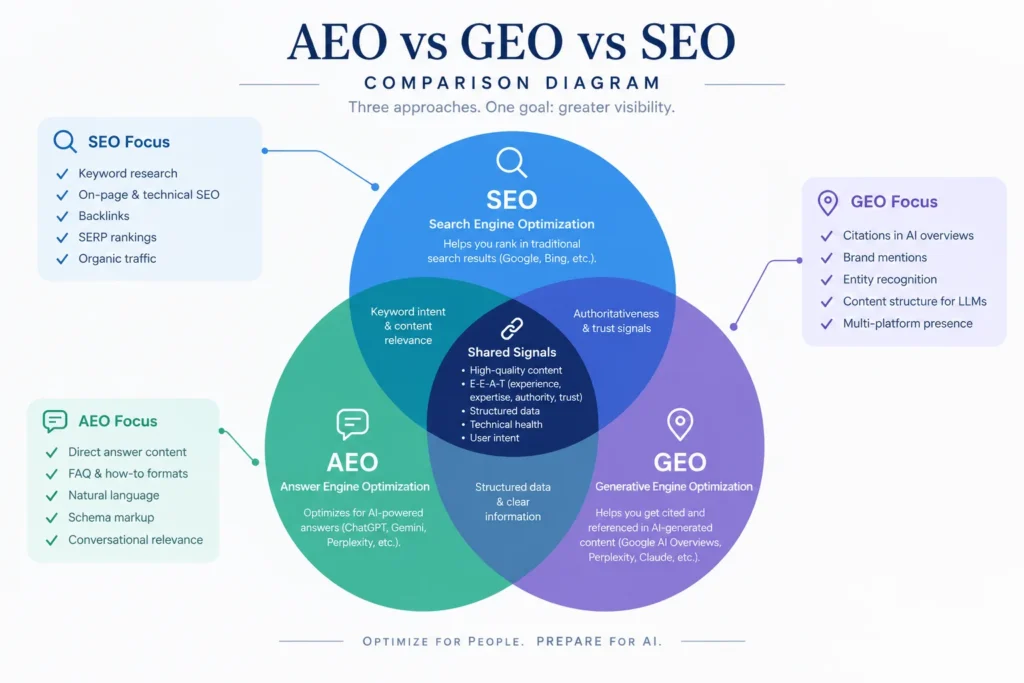
- GEO — Generative Engine Optimization (same practice, different label used in academic research)
- LLM Optimization — Optimizing for Large Language Model extraction
- AI Search Optimization — The broader category including voice, featured snippets, and AI Overviews
All of these terms describe the same strategic goal: making your content the source AI tools extract and attribute.
Why AEO Matters More Than Most Marketers Realize
Here is the number most SEO professionals are not talking about openly yet: Google’s AI Overviews now appear on an estimated 15–25% of all search queries — and that number is rising every quarter. For question-format queries (how, what, why, when, who), the percentage is significantly higher.
When an AI Overview appears, the traditional ten blue links are pushed below the fold. On mobile — which represents over 60% of all search traffic — users often never scroll past the AI answer.
This creates two new realities for your website:
Reality 1: If your content is cited in the AI answer, you receive traffic, brand exposure, and authority signal regardless of your organic ranking position.
Reality 2: If your content is not cited in the AI answer, and an AI Overview appears for a query you previously ranked for, your organic click-through rate for that query can drop by 30–60% even if your ranking position is unchanged.
AEO is not a replacement for SEO. It is the next layer — the practice that determines whether your SEO investment actually produces visibility in the search landscape that now exists, not the one that existed in 2021.
How AI Answer Engines Decide What to Cite
Understanding this is the foundation of everything else in AEO. Most content advice gets this wrong because it treats AI citation like traditional ranking — more content, more keywords, more links. That is not how AI source selection works.
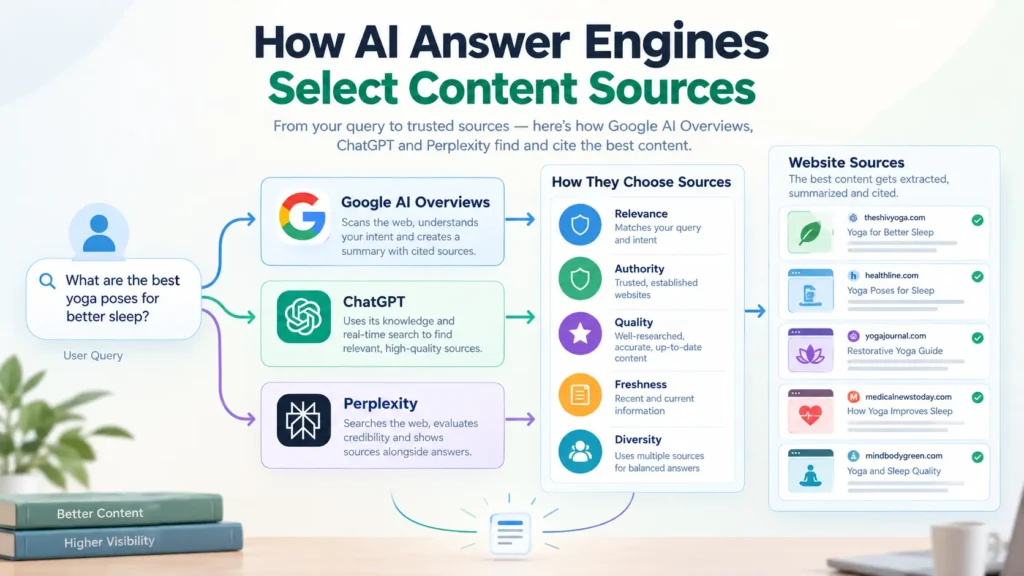
AI answer engines use a multi-signal evaluation process to decide whether a piece of content is worth citing. The key signals are:
Signal 1 — Semantic specificity AI models prefer content that answers one question with precision over content that covers many questions broadly. A 300-word article that defines “what is AEO” in a single, clear, structured section is more likely to be extracted than a 4,000-word guide that mentions AEO across dozens of paragraphs without a clear definition block.
This is why semantic specificity — the practice of writing tight, precise answers to individual questions rather than long, exploratory essays — is the core technical skill of AEO.
Signal 2 — Factual verifiability AI models are trained to prioritize content whose claims can be cross-referenced against other authoritative sources. If your content makes a claim — a statistic, a definition, a cause-and-effect relationship — that appears on multiple trusted sources in the same form, the AI is more likely to surface it. Content that makes unverifiable claims, uses vague language (“many experts say…”), or states things that conflict with established sources is deprioritized.
This is why canonical sourcing — explicitly attributing statistics and claims to named, dated, verifiable sources — is an AEO ranking factor, not just an editorial standard.
Signal 3 — Entity clarity AI models organize knowledge around entities — specific people, organizations, concepts, places, and things. Content that clearly establishes its own entity (your brand, your expertise, your topic) and connects it to related entities through structured markup and consistent naming is easier for AI to place in context and therefore more likely to be cited.
Signal 4 — Answer block structure Content formatted in answer-first structure — where a question is followed immediately by a direct, complete answer in the opening sentence or paragraph, before any qualification or elaboration — is significantly more likely to be extracted than content where the answer is buried after background information.
Signal 5 — Misinformation inoculation AI models — particularly those with safety and accuracy layers — actively deprioritize content that could spread incorrect information. Content that acknowledges counterarguments, notes limitations of its claims, and distinguishes between established facts and evolving interpretations signals to AI that it is a reliable, accurate source. This is not about adding disclaimers. It is about writing with genuine epistemic care — being specific about what is known, what is debated, and what is still emerging.
AEO vs SEO: What Actually Changed
The question most marketers ask first: do I need to choose between them?
No. But you need to understand where they overlap and where they diverge.
| Dimension | Traditional SEO | Answer Engine Optimization |
|---|---|---|
| Target | Ranked position in results list | Citation in AI-generated answer |
| Metric | Click-through rate, ranking position | AI citation rate, featured snippet capture |
| Content format | Long-form, comprehensive coverage | Answer-first, semantically specific blocks |
| Primary signal | Backlinks, domain authority, on-page keywords | Factual precision, entity structure, answer formatting |
| Query type | Broad keyword matching | Intent-specific question matching |
| User behavior | Click through to website | Often answered without a click (zero-click) |
| Tools | Google Search Console, Ahrefs | Perplexity brand monitoring, AI Overview tracking |
The strategies are not opposites. A well-structured, authoritative, entity-clear page that ranks well on Google is also a strong candidate for AI citation. But the specific content formatting, semantic structure, and factual discipline required for AEO goes beyond what traditional keyword-focused SEO requires.
The businesses that will win in AI search are those that do both: build topical authority through traditional SEO and restructure their content architecture for AI extraction.
The 5 Content Types AI Answer Engines Extract Most Often
Not all content gets cited equally. Based on how AI models are structured and what types of content appear most frequently in AI-generated answers, these five content formats have the highest extraction rate:
1. Precise definitions A clear, one-to-three sentence definition of a term or concept, placed under a heading that is phrased as the question the user is asking. This is the single highest-citation content format across all major AI answer engines.
2. Numbered step-by-step guides Procedural content structured as ordered steps, each with a short heading and a one-to-two sentence explanation. AI models extract these reliably because the numbered format maps clearly to “how to” queries.
3. Comparison tables Factual, structured comparisons between two or more things. Tables are easy for AI to extract because the relationships between data points are explicit in the structure.
4. FAQ blocks Individual questions followed by concise, self-contained answers (under 60 words each). FAQ content matches the question-answer format that AI engines are trained to recognize and reproduce.
5. Statistic + source citations A specific, quantified claim attributed to a named, dated, authoritative source. AI models cite these because they are verifiable — the AI can cross-reference the claim against other sources and confirm it before including it in a response.
How to Optimize Your Content for AI Answer Engines: Step-by-Step
Step 1 — Map Your Content to Specific Questions
Start with query fan-out: identify every specific question a person could ask that your content should answer. Not just the primary keyword, but the full cluster of related questions that a user exploring this topic will naturally ask.
For example, if your primary topic is “digital marketing for small businesses,” your question map might include:
- What is digital marketing for small businesses?
- How much should a small business spend on digital marketing?
- What digital marketing channels work best for small businesses?
- How long does it take for digital marketing to produce results for a small business?
- What is the difference between SEO and paid advertising for small businesses?
Each of these questions deserves its own answer block — a heading phrased as the question, followed immediately by a complete, precise answer.
Step 2 — Write Answer-First, Not Context-First
Most content is written context-first: background information, then the answer. AI engines extract answer-first content more reliably.
Context-first (harder to extract): “Digital marketing has evolved significantly over the past decade. With the rise of social media, content marketing, and search engine optimization, businesses now have more options than ever before for reaching customers online. One of the most important developments has been…”
Answer-first (AI-extractable): “Digital marketing for small businesses works best when it combines three channels: SEO for long-term organic traffic, paid search for immediate lead generation, and content marketing for audience trust. Each channel serves a different stage of the customer journey.”
The second version answers the implicit question in the first two sentences. An AI can extract it, quote it, and cite it. The first version requires an AI to interpret context before finding the answer — and it often will not bother.
Step 3 — Build Semantic Specificity Into Every Section
Every H2 and H3 in your content should answer one specific question — and the opening sentence of that section should answer it directly.
Use this structure for every section:
[H2/H3: The question, phrased as a reader would ask it]

[First sentence: The complete answer to that question]

[Remaining paragraph: Evidence, elaboration, examples]
This structure makes each section independently extractable. An AI reading your page does not have to process the whole article — it can identify the section relevant to a user’s query, extract the opening answer, and cite your page.
Step 4 — Establish Entity Clarity
Make sure your page clearly establishes:
- What entity you are — your brand, your expertise, your location
- What entity you are writing about — the topic, concept, or subject
- How these entities relate — your brand’s relationship to the topic
Practically, this means:
- Your brand name appears naturally in the content, not just in the header
- You use consistent terminology throughout (do not alternate between “AEO,” “answer engine optimization,” and “AI search optimization” interchangeably — pick the primary term and use it consistently)
- Your About page, your service pages, and your blog posts all establish the same entity description for your brand
Step 5 — Cite Sources for Every Factual Claim
Every statistic, research finding, or authoritative claim in your content should be attributed to a named, dated source. This is not optional for AEO.
Weak (low AI extraction likelihood): “Studies show that AI search is growing rapidly.”
Strong (high AI extraction likelihood): “According to SparkToro’s 2024 Zero-Click Search Study, approximately 58.5% of Google searches in the US end without a click to any website — up from 50% in 2019.”
The second version is verifiable. An AI can cross-reference it. That verifiability is what makes it extractable.
Step 6 — Add Misinformation Inoculation Signals
This is the AEO practice most content guides miss entirely.
AI models that have been fine-tuned for accuracy — particularly Google’s systems and safety-conscious AI tools — downweight content that makes unqualified absolute claims. Content that acknowledges nuance, distinguishes between what is established and what is emerging, and proactively notes common misconceptions signals epistemic reliability.
Practically, this means:
- Note when a topic is still evolving: “AEO is an emerging field — these practices reflect current AI behavior as of mid-2025, and the signals may shift as AI models are updated.”
- Address common misconceptions directly: “A common misunderstanding: AEO does not replace SEO. Organic rankings still drive significant traffic for most websites — AEO adds a layer, it does not replace the foundation.”
- Distinguish between correlation and causation: “Pages with higher domain authority tend to be cited more frequently in AI answers — though this appears to be a correlation with content quality rather than a direct citation signal.”
This type of epistemic care does not make your content less confident. It makes it more trustworthy to both human readers and AI evaluation systems.
Step 7 — Implement Schema Markup for Every Answer Block
Schema markup gives AI systems explicit, machine-readable signals about the structure of your content. For AEO, these schema types produce the highest citation rate:
- FAQPage schema — for every FAQ section
- HowTo schema — for every step-by-step guide
- Article schema — for every blog post and guide
- DefinedTerm schema — for explicit definition blocks
- Speakable schema — for content optimized for voice and audio AI responses
Step 8 — Monitor and Iterate
AEO is not a one-time optimization. It requires ongoing monitoring of:
- Which of your pages appear in AI Overviews (Google Search Console now surfaces some of this data)
- Whether your brand is cited in Perplexity responses for your target queries (search manually and track weekly)
- Whether your content appears in ChatGPT’s web-browsing responses (test by asking ChatGPT questions your content should answer)
- Your featured snippet capture rate in traditional Google results (a strong leading indicator for AI citation)
For a free monthly routine, read my guide to tracking your AI search visibility.
Content Strategy for an AI Answer-First Model
Moving from a traditional content strategy to an AEO-first model requires changes at the structural level — not just the sentence level.
From topic coverage to question coverage Traditional content strategy asks: “What topic should we write about?” AEO content strategy asks: “What specific questions are our target readers asking, and do we have a dedicated, precise answer for each one?”
From keyword density to answer density The metric changes from “does this keyword appear enough times?” to “does this page contain a complete, self-contained answer to each of its target questions?”
From long-form authority to modular authority A 5,000-word pillar page performs well for traditional SEO. For AEO, that same 5,000 words performs better when structured as 15–20 discrete answer blocks — each one independently extractable — than as a continuous narrative that requires an AI to read the whole page to find the answer it needs.
From brand-first to source-first AEO content leads with the answer, not with the brand. The brand earns citation through the quality and precision of its answers — not through promotional framing at the top of every section.
AEO for Small Businesses: Is It Worth It?
The honest answer is that AEO is more valuable for small businesses than for large ones — because it is one of the few places where content quality and structural precision matter more than domain authority and backlink volume.
A small business with a 20 DA (Domain Authority) but a precisely structured, semantically specific, factually rigorous answer to a specific question can be cited by Google’s AI Overviews over a 70 DA competitor whose answer to the same question is buried in a long, unstructured article.
This is the AEO opportunity for small businesses: the playing field is not perfectly level, but it is closer to level than traditional keyword-based SEO — and it rewards the kind of deliberate, expert content that small business specialists are often better positioned to produce than generalist large agencies.
If you want to understand how AI-driven marketing and AEO optimization work together as one system, our AI marketing service page covers the full picture of how we build content structures that capture both organic rankings and AI citation at the same time.
Key Takeaways
- AEO is the practice of structuring content so AI answer engines — Google AI Overviews, ChatGPT, Perplexity, Claude, Gemini — extract and cite it in their responses.
- AI answer engines select sources based on semantic specificity, factual verifiability, entity clarity, answer-first structure, and misinformation inoculation signals.
- AEO does not replace SEO. It adds a critical layer that determines whether your SEO investment produces visibility in AI-generated search results.
- The five content formats with the highest AI extraction rate are: precise definitions, numbered step-by-step guides, comparison tables, FAQ blocks, and statistic + source citations.
- Small businesses have a genuine advantage in AEO — content precision and structural quality matter more than domain authority in AI citation.
- Misinformation inoculation — acknowledging nuance and distinguishing established facts from emerging practices — is an AEO signal most content guides do not cover.
- Schema markup (FAQPage, HowTo, Article, DefinedTerm) gives AI systems machine-readable signals that significantly increase citation likelihood.
- AEO results appear faster than traditional SEO: structural changes to existing pages can surface in AI answers within two to eight weeks.
FAQ Section
Q1: What is the difference between AEO and SEO?
SEO optimizes content to rank in a list of search results. AEO optimizes content to be extracted and cited by AI answer engines — like Google’s AI Overviews, ChatGPT, and Perplexity — as the source of their response. Both matter. AEO adds a layer on top of traditional SEO rather than replacing it.
Q2: Does AEO replace traditional SEO?
No. Organic rankings still drive significant traffic for most websites. AEO targets AI-generated answer placements that traditional SEO does not reach. The strongest strategy combines both: build domain authority and rankings through SEO, then structure content for AI extraction through AEO.
Q3: How do I know if my content is being cited by AI tools?
Search for your target questions manually in Google (look for AI Overviews), Perplexity, and ChatGPT with web browsing enabled. Google Search Console is also beginning to surface some AI Overview impression data. Track these manually on a weekly basis until dedicated AEO monitoring tools become more widely available.
Q4: Is AEO only for large websites with high domain authority?
No — and this is one of AEO’s key advantages for small businesses. AI engines prioritize content precision, semantic structure, and factual accuracy over domain authority. A small business with a well-structured, specific answer to a targeted question can be cited over a large competitor with a higher-authority but less precisely formatted page.
Q5: How long does it take to see results from AEO?
AEO results appear faster than traditional SEO rankings. Structural changes to existing pages — adding answer blocks, FAQ schema, and precise definition sections — can begin appearing in AI-generated answers within two to eight weeks. New pages targeting specific question keywords can be indexed and cited within four to twelve weeks, depending on crawl frequency and content quality.
Start with one page. Pick your most important topic. Restructure its answer blocks. Add schema. Cite your sources. Test whether it appears in AI-generated answers in four weeks.
Then bring that same approach to every page on your site — systematically, with measurement, until your brand is the source AI cites for every question your customers ask.
Conclusion
AEO is not coming. It is here.
Every day, your potential customers type questions into Google, ChatGPT, and Perplexity and receive answers that cite specific websites. Those websites did not get there by accident. They structured their content to be extracted. They wrote answers before they wrote explanations. They cited sources that AI models could verify. They told AI systems exactly what their content was about through schema markup.
The good news: most of your competitors have not done any of this yet.
That gap closes fast — but right now, the businesses that move first on AEO gain citation share that is genuinely difficult for slower competitors to displace. An AI model that has learned to trust your content as a reliable source for a topic tends to continue citing it, because AI systems train on patterns of reliability.
Start with one page. Pick your most important topic. Restructure its answer blocks. Add schema. Cite your sources. Test whether it appears in AI-generated answers in four weeks.
Then bring that same approach to every page on your site — systematically, with measurement, until your brand is the source AI cites for every question your customers ask.
If you want that process handled for you — the AEO audit, the content restructuring, the schema implementation, and the ongoing citation monitoring — that is exactly what our AI-driven marketing and AEO service is built to do.
Get My Free AI Search Visibility Audit →

- SEO Audit Checklist: 40 Checks You Can Run With Free Tools - October 20, 2026
- How to Track Your Brand’s Visibility in ChatGPT and AI Search - October 3, 2026
- AEO vs GEO vs SEO: What’s the Difference? (2026 Guide) - September 23, 2026