Quick Answer Box
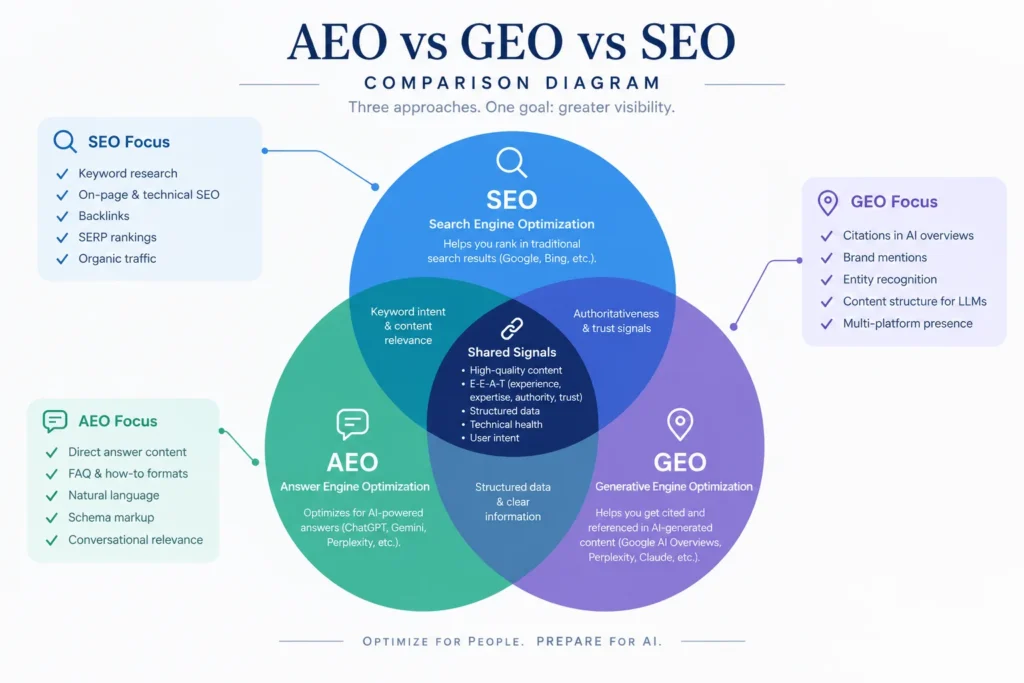
SEO (Search Engine Optimization) ranks your content in Google’s blue-link results. AEO (Answer Engine Optimization) structures your content so AI tools like ChatGPT and Perplexity cite it in their answers. GEO (Generative Engine Optimization) is a broader academic term covering optimization for any AI-generated search output — making it largely interchangeable with AEO in practice. All three share the same technical foundation. The difference is in what you are optimizing for: a ranked position, an AI citation, or both.
Three terms. Endless confusion.
If you have spent any time researching modern search strategy, you have almost certainly hit a wall of overlapping jargon — AEO vs GEO vs SEO — each one presented by a different expert as the thing you urgently need to be doing right now.
Here is the honest picture: two of these three terms describe almost identical practices. One of them has been around for 30 years. And all three share more common ground than most content about them would have you believe.
This guide cuts through the noise. By the end you will know exactly what each term means, where they genuinely differ, and — more practically — which one your business should be prioritizing given where search is heading in 2026.
Get a Free AI Search Visibility Audit for Your Website →
What Is SEO?
SEO — Search Engine Optimization — is the practice of improving a website’s visibility in organic search engine results. It has been the dominant digital marketing discipline since the late 1990s and remains the foundation of every other search optimization strategy discussed in this guide.
Traditional SEO works across three layers:
Technical SEO — ensuring search engines can crawl, index, and render your website correctly. This covers site speed, mobile responsiveness, Core Web Vitals, structured data, and XML sitemaps.
On-page SEO — optimizing individual pages for specific keywords through title tags, headings, content depth, internal linking, and semantic keyword coverage.
Off-page SEO — building the authority signals that tell Google your site is trustworthy and worth ranking. Backlinks from relevant, authoritative sources remain the strongest off-page signal.
The output of traditional SEO is a ranked position in a list of blue links. When someone searches “digital marketing agency for small businesses,” SEO determines whether your page appears on page one, page two, or not at all.
What SEO optimizes for: A ranked position in the traditional SERP (Search Engine Results Page).
How long it takes: 3–6 months for meaningful ranking movement on competitive keywords.
Who it is for: Every business with a website. SEO is the non-negotiable foundation — nothing in AEO or GEO works without it.
What Is AEO?
AEO — Answer Engine Optimization — is the practice of structuring content so that AI-powered answer engines extract and cite it when responding to user queries.
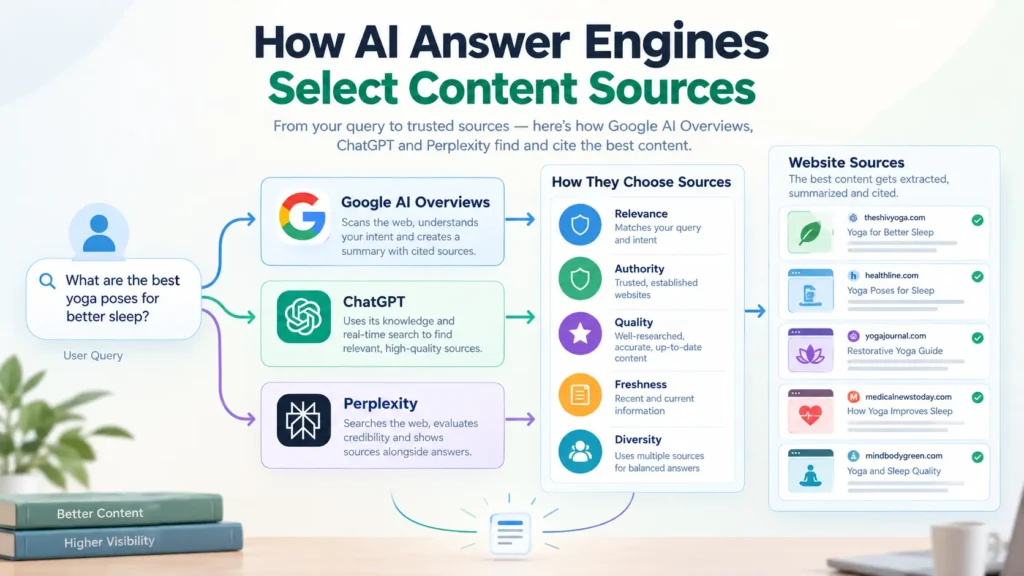
The term reflects a real shift in how people search. Google’s AI Overviews now appear on an estimated 15–25% of all queries. ChatGPT with web browsing, Perplexity, and Gemini collectively answer millions of questions per day by pulling content from the web and presenting it as synthesized responses. The websites those tools cite receive traffic and brand attribution. The websites they do not cite — regardless of their organic ranking — get nothing from those interactions.
AEO focuses on the specific content signals that make a page more likely to be extracted and cited:
- Answer-first structure — opening every section with a direct, complete answer before elaboration
- Semantic specificity — one precise answer per heading, not broad topic coverage
- Factual verifiability — claims attributed to named, dated, authoritative sources
- Schema markup — FAQPage, HowTo, Article, and DefinedTerm structured data
- Misinformation inoculation — acknowledging nuance and distinguishing established facts from emerging ones, which signals epistemic reliability to AI evaluation systems
What AEO optimizes for: Citation in AI-generated answers across Google AI Overviews, ChatGPT, Perplexity, Claude, and Gemini.For a full breakdown of how each of these signals works, read our guide on how answer engine optimization works in practice.
How long it takes: Structural changes to existing pages can appear in AI answers within 2–8 weeks — faster than traditional SEO.
Who it is for: Any business that wants visibility in AI search responses, not just ranked positions. Particularly valuable for informational and research-intent queries where AI Overviews appear most frequently.
What Is GEO?
GEO — Generative Engine Optimization — is an academic term that emerged from a 2023 research paper by a team at Princeton and Georgia Tech. It describes the optimization of content for generative AI search systems — systems that generate their own answers rather than returning a list of results.
In practical terms, GEO and AEO describe the same thing.
The distinction that occasionally gets drawn is one of scope: GEO is sometimes used as the broader category (covering all generative AI search surfaces) while AEO is used more specifically for answer-format queries. In practice, the two terms are used interchangeably by most practitioners, and the optimization strategies they prescribe are identical.
It is also worth noting what Google itself says about this. Google’s official guidance on optimizing for generative AI features — published in 2026 — states explicitly that AEO and GEO are effectively rebranded SEO. AI Overviews and AI Mode are grounded in the same ranking and quality systems as classic Search. The signals that matter — quotability, attribution, heading hierarchy, content freshness, E-E-A-T — are SEO fundamentals applied to AI search surfaces, not a separate discipline.
What GEO optimizes for: The same thing as AEO — citation and visibility in generative AI search outputs.
How long it takes: Same timeline as AEO — 2–8 weeks for existing page improvements.
Who it is for: The same audience as AEO. If you are doing AEO, you are doing GEO.
AEO vs GEO vs SEO: Full Side-by-Side Comparison
| Dimension | SEO | AEO | GEO |
|---|---|---|---|
| Full name | Search Engine Optimization | Answer Engine Optimization | Generative Engine Optimization |
| Origin | Late 1990s | ~2022–2023 | 2023 (academic) |
| Target output | Ranked position in blue-link SERP | AI-generated answer citation | AI-generated answer citation |
| Primary platforms | Google, Bing | Google AI Overviews, ChatGPT, Perplexity, Gemini | Same as AEO |
| Core signals | Backlinks, technical health, keyword relevance | Answer-first structure, semantic specificity, schema, factual sourcing | Same as AEO |
| Content format | Comprehensive, keyword-targeted | Answer blocks, FAQ structure, definition blocks | Same as AEO |
| Time to results | 3–6 months | 2–8 weeks | 2–8 weeks |
| Replaces SEO? | — | No — adds a layer | No — adds a layer |
| Distinct from each other? | Yes — different target | Slightly different from GEO in scope | Slightly different from AEO in scope |
| Google’s view | Core discipline | Rebranded SEO | Rebranded SEO |
The Honest Overlap
The most important thing to understand about AEO vs GEO vs SEO is that the three are not competing strategies. They are layered practices that share a common technical foundation.
A page that ranks well in traditional SEO — technically sound, authoritative, well-structured, factually accurate — is also a strong candidate for AI citation. Google’s own documentation confirms this: AI Overviews draw from the same index and apply the same quality signals as traditional Search.
The specific additions that AEO and GEO bring on top of traditional SEO are:
1. Answer-first formatting Traditional SEO content often buries the answer after context-setting. AEO-optimized content opens every section with the complete answer in the first sentence. This is the single highest-impact change for AI citation readiness.
2. Schema markup precision Traditional SEO uses schema broadly. AEO prioritizes FAQPage, HowTo, and DefinedTerm schema specifically — the types that map directly to the question-answer format AI models are trained to recognize.
3. Source attribution for claims Traditional SEO does not require explicit sourcing for every claim. AEO does. AI models are more likely to extract and cite a claim that is attributed to a named, dated, verifiable source — because they can cross-reference it before including it in a response.
4. Misinformation inoculation This is the least-discussed AEO signal. Content that acknowledges nuance, addresses common misconceptions, and distinguishes between established and emerging knowledge signals epistemic reliability to AI evaluation systems. It makes content less likely to be filtered out on accuracy grounds.
Does AEO Actually Work for Small Businesses?
Yes — and it may work better for small businesses than for large ones.
Traditional SEO heavily favors high-domain-authority sites with large backlink profiles. A small business competing for a high-volume keyword against an established competitor with a 70+ DA is fighting uphill.
AEO partially levels that playing field. AI models prioritize content precision, semantic structure, and factual accuracy over domain authority. A small business page with a precisely structured, verifiably accurate answer to a specific question can be cited by Google’s AI Overviews or Perplexity over a competitor with ten times the domain authority whose answer to the same question is buried in a long, unstructured article.
This does not mean domain authority is irrelevant to AEO — higher authority pages are still cited more frequently on average. But the correlation between content quality/structure and AI citation rate is stronger than the correlation between domain authority and AI citation rate.
For a deeper look at ROI, cost, and realistic timelines for small business AEO, read: Does AEO Work for Small Business? Cost, ROI, and Timeline.
Which One Should You Be Doing?
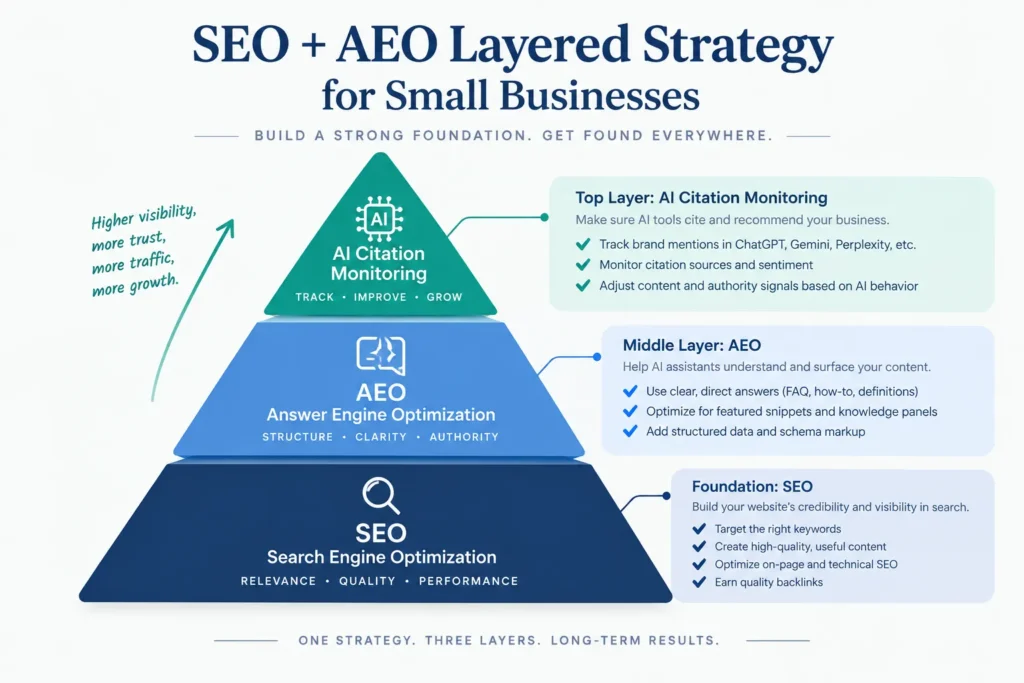
The answer is not one or the other — it is a sequenced approach.
Phase 1 — SEO foundation (if not already solid) No amount of AEO or GEO optimization helps if Google cannot crawl your site, your pages have no topical authority, and you have zero backlinks. Technical SEO and foundational on-page SEO come first.
Phase 2 — AEO/GEO layer on top Once the SEO foundation is solid, restructure your existing content for AI citation. This means adding answer-first openings to each section, implementing precise schema markup, attributing every factual claim to a named source, and building FAQ blocks for your most important topics.
Phase 3 — Monitor and iterate Track your citation rate in Google AI Overviews (via Search Console), Perplexity (manual searches), and ChatGPT (with web browsing enabled). Treat AI citation as a standalone KPI alongside organic rankings and traffic. For the full method, see how to track brand visibility in ChatGPT and AI search.
The businesses that will capture the most search visibility over the next two to three years are those that treat SEO and AEO not as alternatives but as two layers of the same strategy — the second building directly on the foundation of the first.
If you want to understand how AI-driven marketing and AEO work as one integrated system for small businesses, our AI marketing service page covers the full approach we use with every client.
Key Takeaways
- SEO targets ranked positions in traditional search results. It is the non-negotiable foundation — 30 years old and still the dominant discipline.
- AEO targets citation in AI-generated answers. It adds specific formatting, schema, and sourcing practices on top of SEO fundamentals.
- GEO is effectively the same as AEO — an academic term for optimizing generative AI search surfaces that practitioners use interchangeably with AEO.
- All three share the same technical foundation. Google confirms that AI Overviews and AI Mode are grounded in the same quality signals as classic Search.
- AEO results appear faster than traditional SEO — 2–8 weeks vs 3–6 months — because it targets AI citation rather than algorithm-driven rankings.
- Small businesses have a genuine advantage in AEO: content precision and structure matter more than domain authority for AI citation.
- The right strategy is sequential: SEO foundation first, AEO layer second, measurement third.
FAQ
Q: Is AEO better than SEO?
AEO is not better than SEO — it is an additional layer on top of SEO. Organic rankings still drive the majority of website traffic for most businesses. AEO captures a growing share of search interactions that traditional SEO alone does not reach, particularly AI-generated answer placements.
Q: Do I need to do GEO and AEO separately?
No. GEO and AEO describe the same optimization practices. If you are implementing AEO — answer-first structure, schema markup, factual sourcing — you are doing GEO. You do not need a separate GEO strategy.
Q: Does traditional SEO still matter in 2026?
Yes — significantly. Google’s AI Overviews and AI Mode draw from the same index as traditional Search. A page needs to be indexable, authoritative, and technically sound before it can be cited in AI answers. Traditional SEO is the prerequisite, not the alternative.
Q: How do I know if my content is being cited in AI answers?
Check Google Search Console for AI Overview impression data (increasingly available), search your target questions manually in Perplexity and ChatGPT with web browsing enabled, and track whether your brand or pages appear in the responses. Treat this as a weekly monitoring task.
Q: What is the single most impactful AEO change I can make today?
Rewrite the opening sentence of every H2 section on your most important pages to directly and completely answer the question implied by that heading — before any context, background, or elaboration. This single change improves AI extraction likelihood more than any other structural adjustment.

- SEO Audit Checklist: 40 Checks You Can Run With Free Tools - October 20, 2026
- How to Track Your Brand’s Visibility in ChatGPT and AI Search - October 3, 2026
- AEO vs GEO vs SEO: What’s the Difference? (2026 Guide) - September 23, 2026